

Run a written preventive maintenance calendar with clear daily, weekly, monthly, quarterly and annual bands. Assign one named owner to each task and require a signed log entry every time it’s completed. This combination of cadence, ownership and audit trail is what keeps commercial kitchens out of emergency repair bills and ready for any inspection without notice.
TL;DR:
- Assign a dedicated owner to each equipment task to ensure accountability and prevent missed maintenance, especially for critical calibration and safety checks.
- Tighten frequency intervals for high-risk environments such as high-volume kitchens or areas with hard water to prevent accelerated wear and potential safety issues.
- Conduct regular audits by reviewing logs and calibration dates weekly and quarterly to verify actual completion and catch overlooked tasks early.
- Choose equipment with accessible service panels and reliable spare parts to reduce maintenance time and avoid extended downtime or costly repairs.
- Use equipment-specific checklists displayed on or near units to improve staff compliance and streamline maintenance while maintaining thorough documentation for audits.
Table of Contents
- How do you structure a kitchen equipment maintenance schedule?
- Equipment-specific maintenance checklists by category
- Who owns the maintenance log, and what goes in it?
- Building and running the schedule day to day
- Why equipment choice affects your maintenance burden
- What actually derails a maintenance schedule?
- Reduce your maintenance load before it starts
- Sources
- FAQ
How do you structure a kitchen equipment maintenance schedule?
A working kitchen equipment maintenance schedule runs on five cadence bands, each tied to a specific risk. Daily tasks catch the small problems before they become breakdowns. Annual tasks satisfy the safety and warranty obligations that keep insurers and inspectors satisfied. Skipping a band doesn’t save time; it just moves the cost forward, usually to a Friday night service failure.
Here’s how the bands typically break down:
- Daily — end-of-service cleaning, fridge and freezer temperature logging, wiping down cooking surfaces, checking door seals for obvious damage.
- Weekly — deep-cleaning griddles, boiling out fryers, cleaning ice machine bins, checking hood filters.
- Monthly — cleaning refrigeration condenser coils, inspecting gaskets closely, testing chemical concentrations in dishwashers.
- Quarterly — technician-led refrigeration servicing, hood and duct cleaning, fire-suppression system checks.
- Annual — gas safety inspections, electrical testing, compressor servicing, full equipment audits against manufacturer specifications.
A preventive schedule built on these bands can extend equipment life by roughly 25 to 40% compared with reactive, breakdown-only servicing.
These intervals are baselines, not fixed rules. High-volume kitchens, humid environments and areas with hard water all accelerate wear, so shorten the cycle rather than wait for the manufacturer’s default to catch up with reality. A fryer running two services a day needs weekly boil-outs at minimum; a quiet catering kitchen might stretch that slightly. Build in thermostat and thermometer calibration checks every three to six months regardless of volume, since drifting sensors are one of the most common causes of undetected food safety issues in otherwise well-run kitchens.
Equipment-specific maintenance checklists by category
Different equipment classes fail in different ways, so a single generic checklist rarely covers a working kitchen. Below are practical, copyable checklists organised by equipment class, each built around the daily to annual structure covered above.
Refrigeration (chillers, freezers, walk-ins)
- Daily: log temperatures morning and evening; check door gaskets and seals for gaps.
- Monthly: clean condenser coils, since dust and grease buildup forces compressors to work harder and shortens their working life.
- Quarterly: book a technician inspection covering refrigerant levels and compressor health.
- Annual: obtain a service certificate confirming compressor condition, particularly important if the unit is still under warranty.
Manufacturer documentation, such as the preventative maintenance guidance KitchenAid publishes for its refrigeration units, lists model-specific tasks like interior cleaning and filter replacement that should sit alongside your general checklist, not replace it. A well-sealed chiller or freezer with accessible coils makes this entire category faster to maintain.
Cooking line (ranges, ovens, griddles)
- Daily: wipe down and degrease all surfaces at close.
- Weekly: run a deeper clean on griddles and grease traps.
- Monthly: calibrate thermostats and inspect heating elements for wear.
- Quarterly: arrange servicing where the manufacturer specifies it, particularly for gas-fired units.
Ovens with awkward access panels turn a ten-minute calibration check into a half-hour job. If you’re replacing ageing units, look at how easily the service panel opens on options like a double deck oven or a 90-litre oven before you buy, not after the first breakdown.
Fryers
- Daily: skim and filter oil after each service period.
- Weekly: full boil-out to clear carbon deposits from heating elements.
- Monthly: check burner condition, thermostat accuracy and o-ring seals for oil leaks.
Oil management is the single biggest lever in fryer longevity. Skipping the weekly boil-out lets carbon build up on elements, which slows heat transfer and pushes the unit to run hotter and longer to compensate.
Dishwashers and steamers
- Daily: rinse and fully drain at the end of service.
- Weekly: delime spray arms and internal surfaces, especially in hard water areas.
- Monthly: test chemical concentration levels against manufacturer specifications.
- Quarterly: book a technician service for pumps and heating elements.
Ice machines
- Weekly: clean the ice bin thoroughly.
- Monthly: brush the condenser to remove dust.
- Every three to six months: sanitise the full system, descale, and replace water filters.
Ice machines carry a food safety risk that other equipment doesn’t: stagnant water and biofilm build-up inside the unit. Sanitisation cycles and regular filter changes aren’t optional extras. Treat them with the same seriousness as fridge temperature logs.
Hoods and ventilation
- Filter cleaning: frequency depends on grease load, but weekly to biweekly is typical for busy kitchens.
- Duct cleaning: high-volume kitchens need this quarterly, performed by qualified contractors, in line with industry fire-safety guidance.
- Fire suppression: annual tagging and inspection, non-negotiable for insurance compliance.
Smallwares and mixers
- Lubrication: check manufacturer-specified points on mixers and slicers monthly.
- Belts and seals: inspect for cracking or slipping during routine servicing.
- Electrical plugs and cords: visually inspect for fraying or damage weekly.
Pro Tip: Keep a laminated version of each equipment-specific checklist taped inside the relevant cupboard or on the equipment itself. Staff are far more likely to complete a task they can see than one buried in a binder in the office.
Who owns the maintenance log, and what goes in it?
Every piece of equipment needs a single named owner, whether that’s a station lead responsible for their section or the head chef holding overall accountability. Shared ownership is how tasks get missed; everyone assumes someone else did it.
Your logbook needs a few fixed fields to be genuinely auditable:
- Equipment ID or serial number
- Task performed and cadence band
- Date and time completed
- Staff initials
- Notes on condition or issues found
- Attached service certificates or photos where relevant
Keying entries to serial numbers matters more than it sounds. Inspectors and insurers often ask for dated records tied to a specific unit, not a general statement that “fridges were checked.” Retain service certificates and calibration records for at least as long as the equipment’s warranty period, longer if your insurer or local food authority specifies a minimum. When an inspector or warranty claim arrives, you want to hand over a dated, signed record in under a minute, not go searching through email threads.
Building and running the schedule day to day
Getting from “we should have a schedule” to one that actually runs takes a defined process rather than good intentions.
- Inventory every piece of equipment, including make, model and serial number.
- Record manufacturer-recommended intervals for each item from its manual.
- Group tasks by cadence band across the whole kitchen, not equipment by equipment.
- Assign an owner to each task, by name, not by role alone.
- Publish the schedule somewhere visible and train staff on it directly.
For tools, a printed grid on the wall works for smaller kitchens where simplicity matters more than reporting. A shared spreadsheet gives more flexibility for multi-site operators who need to compare compliance across locations. A dedicated maintenance management system earns its cost in larger operations by generating automatic reminders and a built-in audit trail, useful when regulatory scrutiny is frequent.
Batch the noisy, disruptive jobs, duct cleaning, deep coil cleans, into quiet trading periods, and book contractor windows around known slow weeks rather than scrambling when a breakdown forces the issue.
Pro Tip: Run a short quarterly review of the whole schedule against actual completion rates. If a task is consistently skipped, the problem usually isn’t the staff, it’s that the task is scheduled at an unworkable time or assigned to the wrong person.
Why equipment choice affects your maintenance burden
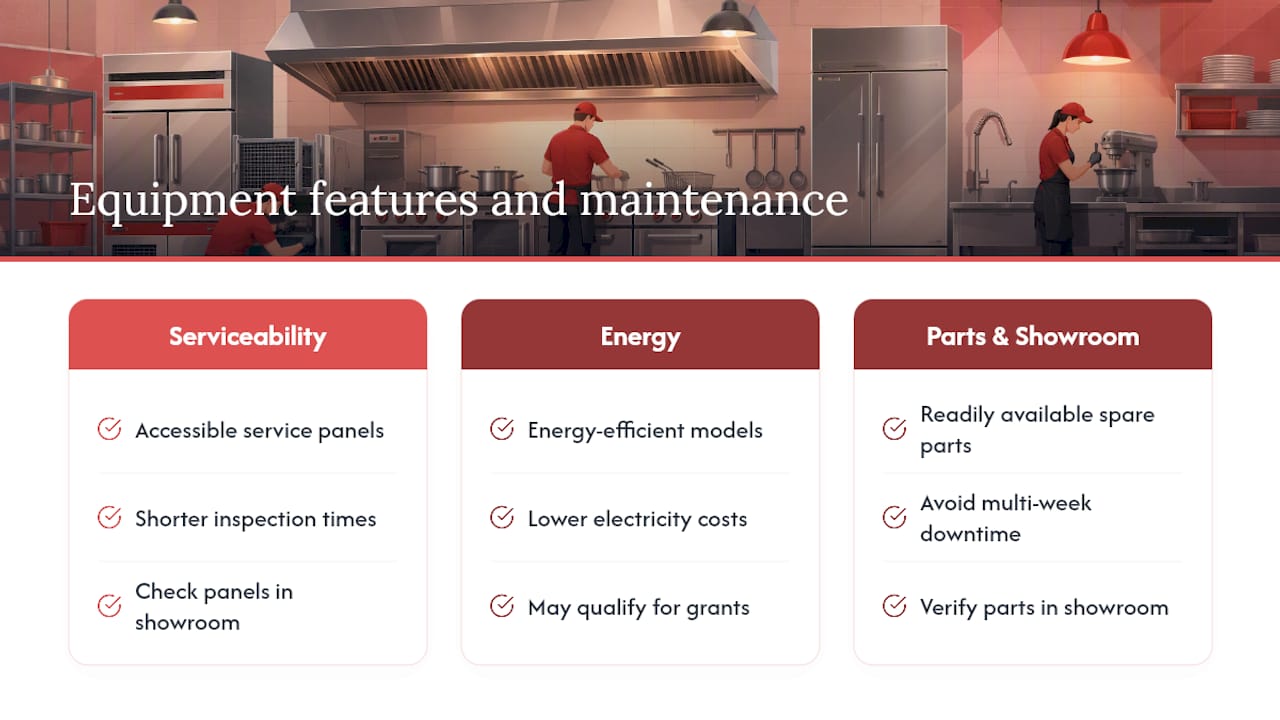
Serviceable, energy-efficient equipment reduces how much maintenance your team has to do in the first place. Units with accessible service panels cut the time technicians spend on quarterly inspections, and models with readily available spare parts avoid the multi-week delays that turn a small fault into extended downtime.
Some suppliers stock equipment selected with these factors in mind, such as energy-efficient units that qualify for government efficiency grants, products that deliver electricity savings compared to older equipment, and showrooms where you can check service access panels and ask about parts availability before purchase.
Visiting the showroom before buying lets you compare access panels side by side, something a product photo online never shows properly.
What actually derails a maintenance schedule?
The three failures I see repeatedly: no single owner assigned to a task, calibration checks quietly skipped because they feel less urgent than cleaning, and logs kept so loosely they’re useless in an audit. Each has a fast fix. Name an owner for every task this week. Put calibration dates on the same calendar as cleaning, not a separate one nobody checks. And run a fifteen-minute weekly audit: pull three random log entries and confirm they match what actually happened on the floor. Pair that with a short quarterly briefing to confirm ownership and contractor bookings are still current, and most schedules stay on track without extra admin.
— David
Reduce your maintenance load before it starts
Energy-efficient, well-designed equipment doesn’t eliminate maintenance, but it cuts down how often you need it and how much each service costs. Suppliers offering commercial kitchen equipment built with serviceability in mind help teams spend less time chasing spare parts and more time running the pass.
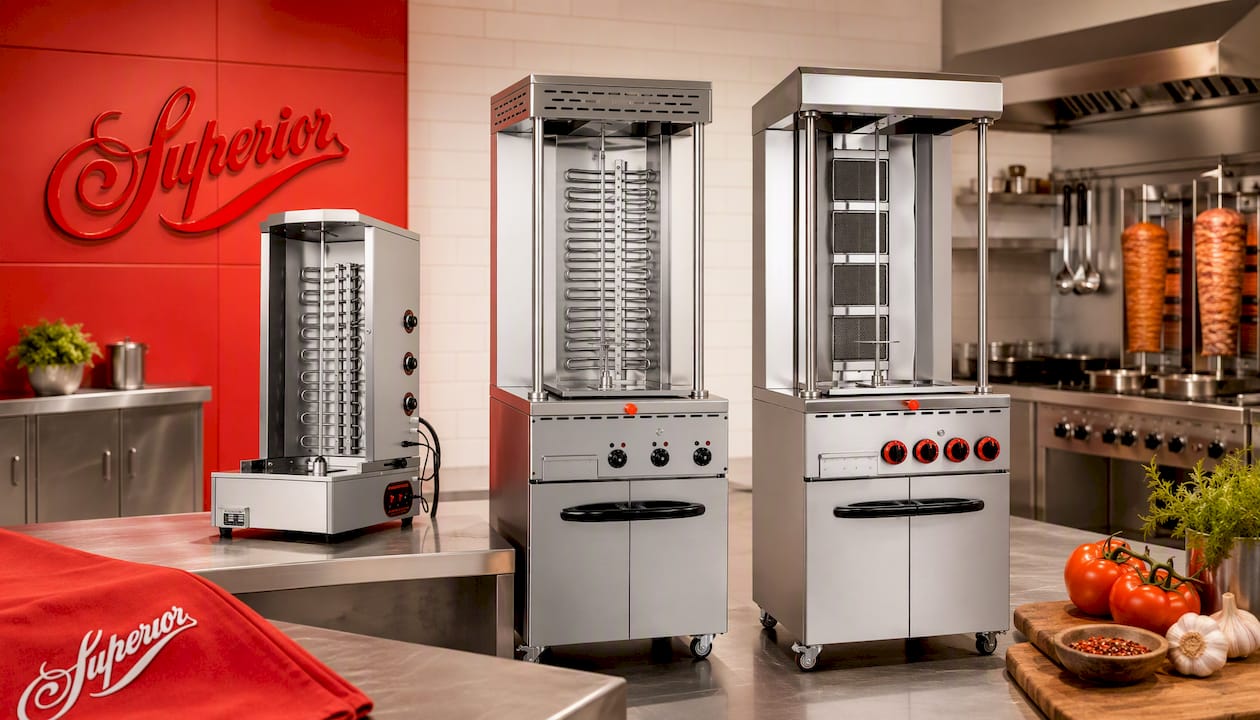
For kitchens running kebab stations, three product lines are worth a look. The tabletop large electric kebab machine suits smaller counters with limited space. The standing electric kebab machine handles higher volume without the gas servicing requirements a gas unit carries. The standing gas kebab machine delivers higher output for busy stations, with contractor servicing scheduled the same way as your other gas-fired equipment.
Visit a showroom to check service access and parts availability in person, or get in touch with suppliers to request serviceability details and a maintenance grid template suited to your kitchen layout.
Sources
- Commercial kitchen equipment maintenance checklist
- Commercial kitchen preventive maintenance guide
- Preventative maintenance for refrigerators — KitchenAid product help
FAQ
What are the main types of maintenance in a commercial kitchen?
Most kitchens run a mix of preventive maintenance (scheduled tasks like coil cleaning), corrective maintenance (fixing a known fault), predictive maintenance (acting on early warning signs like unusual noise), and reactive or emergency repair when something fails without warning.
What should be included in an equipment maintenance checklist?
A solid checklist names the equipment by ID, the task, the required cadence, the person responsible, the date completed, and space for notes or attached service certificates.
What are the general requirements for equipment maintenance?
At minimum, kitchens need daily operational checks, scheduled cleaning at weekly and monthly intervals, technician-led quarterly and annual servicing, and a signed log tying each task to a date and an owner.
What are the five types of preventive maintenance most kitchens use?
The five common bands are daily, weekly, monthly, quarterly and annual tasks, each targeting a different failure risk, from daily cleaning through to annual gas and electrical safety inspections.
How often should refrigeration equipment be serviced?
Temperature checks should happen daily, condenser coils should be cleaned monthly, and a qualified technician should inspect the refrigeration system quarterly, with a full annual service to confirm compressor health.