

Only City Energy or a Licensed Gas Service Worker (LGSW) may legally carry out gas service work in Singapore, and every installation must comply with Singapore Standard SS 608 and the Gas Supply Code. If you are planning a new connection, an alteration, or a commercial kitchen fit-out, stop any DIY plans now: engage an LGSW or contact City Energy directly to begin the application process.
TL;DR:
- Only Licensed Gas Service Workers or City Energy can carry out gas service work, and all installations must meet SS 608 standards and the Gas Supply Code.
- Gas systems require rigorous proof testing and certification before gas admittance, with certificates of fitness due within 30 days post-inspection to avoid fines.
- Extending or modifying existing gas lines demands proof testing of new sections, proper documentation, and cannot be done by simply tapping into existing pipes.
- Maintaining proper records, adhering to inspection cycles, and coordinating with approved professionals are key to ongoing compliance and avoiding costly delays.
- Choosing appliances that match the site’s gas pressure and venting requirements is crucial, and visiting showrooms beforehand helps prevent compatibility issues during commissioning.
Table of Contents
- Gas installation rules Singapore businesses must know: the legal framework
- Who can legally carry out gas installation work
- How to apply for gas connection and admittance
- Testing, inspection intervals and certificate of fitness rules
- A practical compliance checklist for businesses and building managers
- How Superior Kitchen Equipment supports compliant gas installations
- Procedures for modifying or extending an existing gas installation
- Consumer rights and responsibilities for gas installation
- Emergency procedures for gas leaks or faults
- The gap between gas installation guidelines and how businesses actually treat them
- Fitting out a compliant commercial kitchen
- Sources
- FAQ
Gas installation rules Singapore businesses must know: the legal framework
The Gas Act (Cap. 116A) is the parent legislation governing gas supply and safety in Singapore. Beneath it sit two working documents that actually tell you what to do: the Gas (Supply) Regulations, which set legal obligations, and SS 608, the technical code of practice covering design, materials, testing and commissioning. Together, these form the backbone of gas system compliance Singapore relies on.
A handful of terms recur throughout the paperwork, and it pays to know them before you call anyone:
- Gas installation: the pipework, fittings and appliances downstream of the meter or isolation valve.
- Gas service work: any work connecting, altering, testing or decommissioning that installation.
- Leak free: the state an installation must reach and prove before gas is admitted.
- Admittance of gas: the formal act of the gas transporter turning gas into a new or altered system.
The Gas Safety Code requires licensees to keep systems safe “as low as reasonably practicable” (ALARP), which is the regulator’s way of saying risk must be actively managed, not just tolerated. That duty sits with the licensee and with the “responsible person” for each site, whether that is a landlord, a restaurant operator, or a facilities manager.
Who can legally carry out gas installation work
City Energy operates as Singapore’s gas transporter and is the default authority for connection, admittance and meter work. Outside of that, only a Licensed Gas Service Worker may perform gas service work on a system, and the licence is not optional paperwork. It is the legal line between a compliant installation and one that puts your business at risk.
A few points worth knowing before you hire anyone:
- An LGSW’s licence covers standard residential and light commercial work; it does not automatically extend to every industrial configuration.
- Higher-pressure or complex non-residential systems, such as large-scale food manufacturing plants, often require a professional engineer’s certification on top of LGSW work.
- Ask to see the worker’s licence number and cross-check it before work begins, not after.
- The “responsible person” for the premises, not the contractor, ultimately answers to the regulator if compliance fails.
Pro Tip: Keep a photo or scan of the LGSW’s licence with your project file. If an inspector or insurer ever asks who did the work, you want that answer in seconds, not days.
How to apply for gas connection and admittance
Getting gas turned on for a new or altered installation follows a defined sequence, and skipping a step is the single biggest cause of delay.
- Submit an application to the gas transporter, City Energy, with connection plans prepared by your LGSW or engineer. The responsible person or an appointed shipper typically lodges this.
- Complete the installation to SS 608 workmanship standards, using approved materials and fittings throughout.
- Appoint a designated representative, usually the LGSW, to carry out proof tests, cap or seal endpoints correctly, and confirm the system is leak free.
- Certify the installation in writing to the transporter, based on those proof test results.
- Receive the statement of admittance from the transporter once the certification is accepted.
- Meter turn-on follows, carried out by the transporter or an authorised representative, not by the installer or the occupier.
The Gas Supply Code sets out this procedure in full, and it is the document your LGSW should already be familiar with. In practice, most delays happen because the proof test results are incomplete or the connection plans do not match the installed system, not because of the transporter being slow. Building that coordination in early saves weeks.
Testing, inspection intervals and certificate of fitness rules
Before any gas is admitted, the installation must pass a proof test at operating pressure with endpoints properly capped, confirming there are no leaks anywhere along the run. This is not a formality; it is the technical gatekeeper that determines whether admittance happens at all.
Once a system is live, inspection does not stop:
- Residential installations generally follow a five-year inspection programme.
- Inaccessible parts of a system, such as pipework run within walls or under slabs, are inspected on a three-year cycle where accessibility allows.
- Higher-pressure non-residential systems, including many industrial and F&B setups, typically require annual certification given the greater risk profile.
Amendments made in 2025 to the Gas (Supply) Regulations tightened these obligations, confirming that gas service work must comply with SS 608 “as in force from time to time” and clarifying certificate submission rules.
A certificate of fitness must reach the gas transporter within 30 days of inspection. Miss that window, or submit a false certificate, and the regulations set fines of up to $5,000. That is a meaningful figure for a small F&B operator, and it applies whether the lapse was deliberate or simply an administrative oversight.
A practical compliance checklist for businesses and building managers
Compliance is easiest to manage as three phases: before work starts, during the work, and after the system goes live.
- Before work: appoint an LGSW (or a professional engineer for higher-pressure systems), confirm your design and materials meet SS 608, and prepare connection plans for submission to the transporter.
- During work: follow SS 608 workmanship rules exactly, complete every required proof test, and keep the test records rather than relying on a verbal confirmation from the contractor.
- After work: obtain your certificate of fitness, submit it within the 30-day window, and schedule the next inspection based on your installation type.
Pro Tip: Set a calendar reminder six months ahead of your next inspection deadline, not one week before. Booking an LGSW during a busy season can take longer than most operators expect.
Documentation is the part businesses underestimate most. Inspectors and insurers alike will ask for proof test records, not just a certificate, so keep both together and accessible on site.
How Superior Kitchen Equipment supports compliant gas installations
Choosing the right appliance matters just as much as choosing the right installer. A 2 Ring Standing Gas Stove suits a compact kitchen with modest output needs, while a 6 Ring Gas Stove fits higher-volume commercial cooking lines. A Standing Gas Kebab Machine has its own inlet and venting requirements that need checking against your site’s gas service pressure before purchase.
Before buying any gas appliance, confirm these details against your building’s installation:
- The appliance’s pressure rating matches your gas service pressure, or that a regulator is fitted where it does not.
- Flue and venting requirements suit your kitchen layout and ceiling height.
- Inlet connector type is compatible with the pipework your LGSW has installed or will install.
[brand_signal] Visiting the showroom lets you check these specifications against a physical unit before your LGSW finalises connection plans, rather than discovering a mismatch during commissioning.
Procedures for modifying or extending an existing gas installation
Extending a gas line to a new appliance, or altering pipework during a kitchen renovation, is treated as gas service work under the same rules as a new connection. You cannot simply tap into an existing line because the pipe happens to run nearby.
Any alteration must be carried out or supervised by an LGSW, designed to SS 608 standards, and proof tested before the new section is brought into service. The transporter typically needs updated connection plans reflecting the change, particularly where the alteration affects overall system pressure or adds load that the original design did not account for. This matters more than most operators expect: adding a second gas appliance to a kitchen that was piped for one can quietly push the system beyond its intended capacity.
Practical sequence for a modification:
- Notify your LGSW or engineer of the intended change before ordering equipment.
- Confirm the existing pipework and meter can handle the additional load.
- Have the altered section proof tested and certified as leak free, exactly as with a new installation.
- Update your records and certificate of fitness to reflect the amended system.
Skipping the proof test on an extension because “the rest of the system already passed” is one of the more common compliance failures inspectors report. Each new section is a fresh point of failure until it has been tested, and the regulations do not distinguish between old and new pipework when something goes wrong.
Consumer rights and responsibilities for gas installation
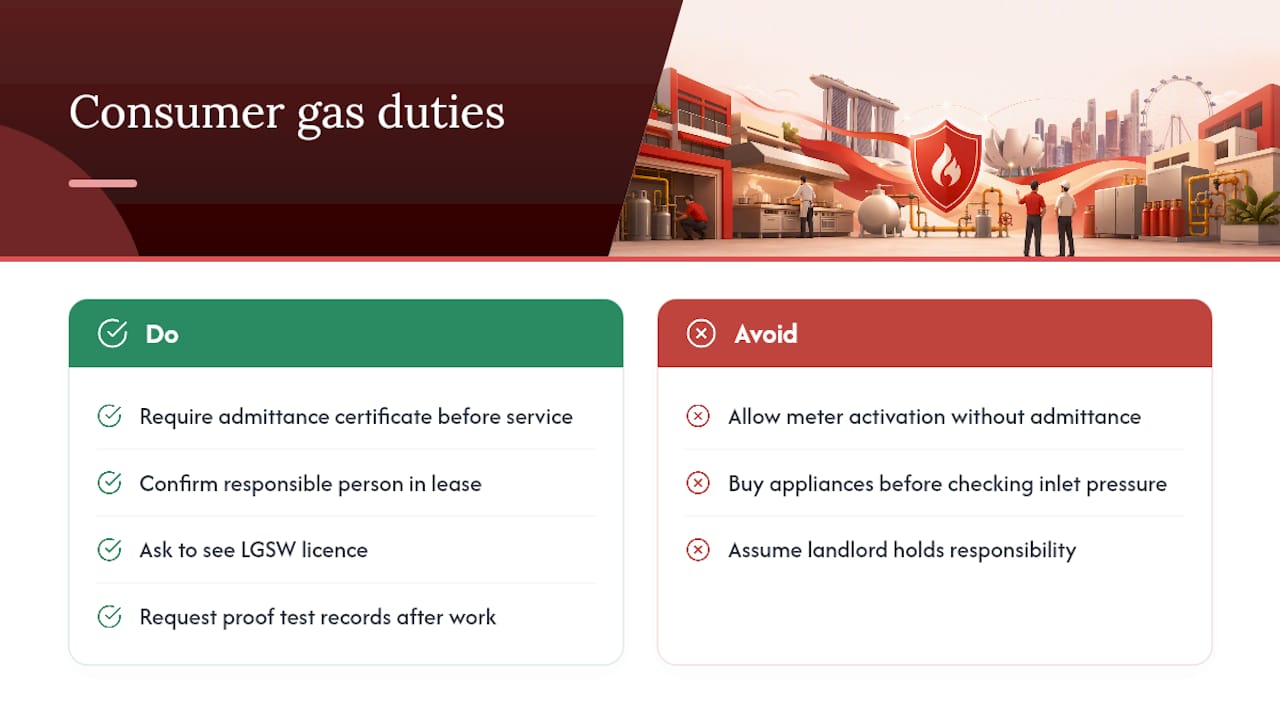
As a gas consumer, whether a homeowner or a business, you have the right to expect that any installation admitted to service has been properly tested and certified. The gas transporter will not turn on a meter without a valid statement of admittance, which exists precisely to protect you from an unsafe system.
Your responsibilities run alongside that protection. The “responsible person” for a premises, often the property owner, tenant, or business operator, is accountable for maintaining the installation and meeting inspection deadlines, not just for the initial connection. If you rent commercial premises, clarify in your lease who holds that responsibility; it is a common gap that surfaces only after an inspection lapse.
You also have the right to request proof of an LGSW’s licence before work begins, and to ask for copies of proof test records once work is complete. A contractor who resists providing either is a warning sign worth heeding. Consumers seeking general guidance on safe practice can consult the Energy Market Authority’s consumer information on gas safety, which summarises who to contact for connections, faults and general enquiries.
For F&B operators specifically, responsibility extends to matching appliances correctly to the installed system. Buying equipment before confirming inlet pressure compatibility is a frequent, avoidable cause of failed commissioning.
Emergency procedures for gas leaks or faults
If you smell gas, act on smell alone, not on whether you can see a visible fault. Turn off the gas supply at the meter control valve if it is safely accessible, open windows and doors for ventilation, and get everyone out of the area immediately.
Do not operate electrical switches, light a flame, or use a mobile phone near the suspected leak; a spark is enough to ignite an accumulation of gas in an enclosed kitchen. Once clear of the area, contact City Energy’s emergency line or your gas retailer’s fault-reporting number, both of which operate around the clock for exactly this situation.
For a business, an emergency plan should be written down, not assumed:
- Post the gas emergency contact number visibly near the kitchen or plant room, not buried in a manual.
- Train staff on the meter shut-off location and how to operate it.
- Report any suspected fault immediately, even a minor one; small leaks rarely stay small.
After any emergency shutdown, do not restore gas supply yourself. Only an LGSW or the transporter should re-certify the system as leak free before turning it back on, which mirrors the same admittance process used for a new connection.
The gap between gas installation guidelines and how businesses actually treat them
Most operators treat gas compliance as a one-off hurdle to clear before opening day. That reading of SS 608 and the Gas Supply Code misses the point entirely. The regulations are built around lifecycle compliance: admittance is the starting line, not the finish, and the five-year and three-year inspection cycles exist because pipework degrades quietly, without any visible warning sign.
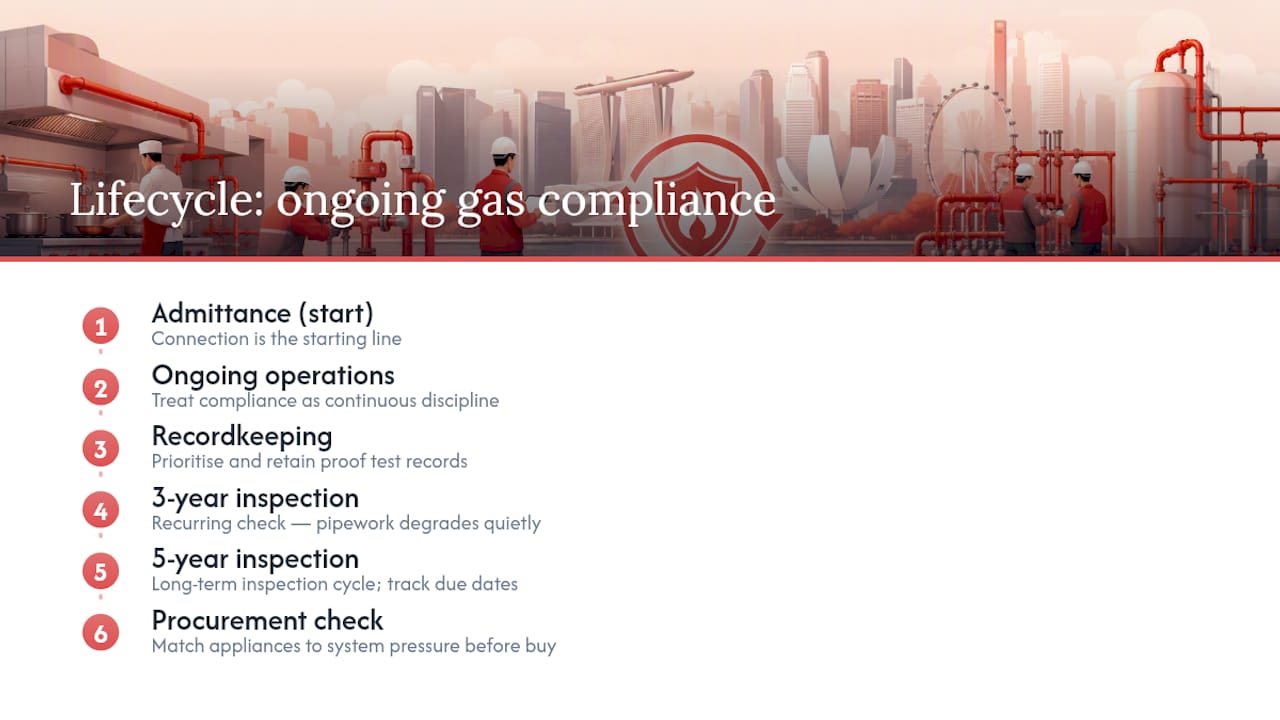
The conventional advice, “get your LGSW, get your certificate, move on,” undersells the recordkeeping burden that follows. Businesses that fail inspections rarely fail because the pipework was badly installed. They fail because proof test records went missing, or because nobody tracked when the next certificate was due. That is an administrative failure dressed up as a technical one.
If you take one thing from this guide, prioritise your paper trail as seriously as your pipework. Match appliances to your system’s actual pressure rating before you buy, not after installation reveals a mismatch. The businesses that avoid costly delays are the ones that treat compliance as ongoing operational discipline, not a box ticked once and forgotten.
— David
Fitting out a compliant commercial kitchen
Superior Kitchen Equipment gives Singapore F&B operators a straightforward way to match appliances to an already-compliant gas installation, rather than discovering a pressure or connector mismatch after your LGSW has signed off the system.
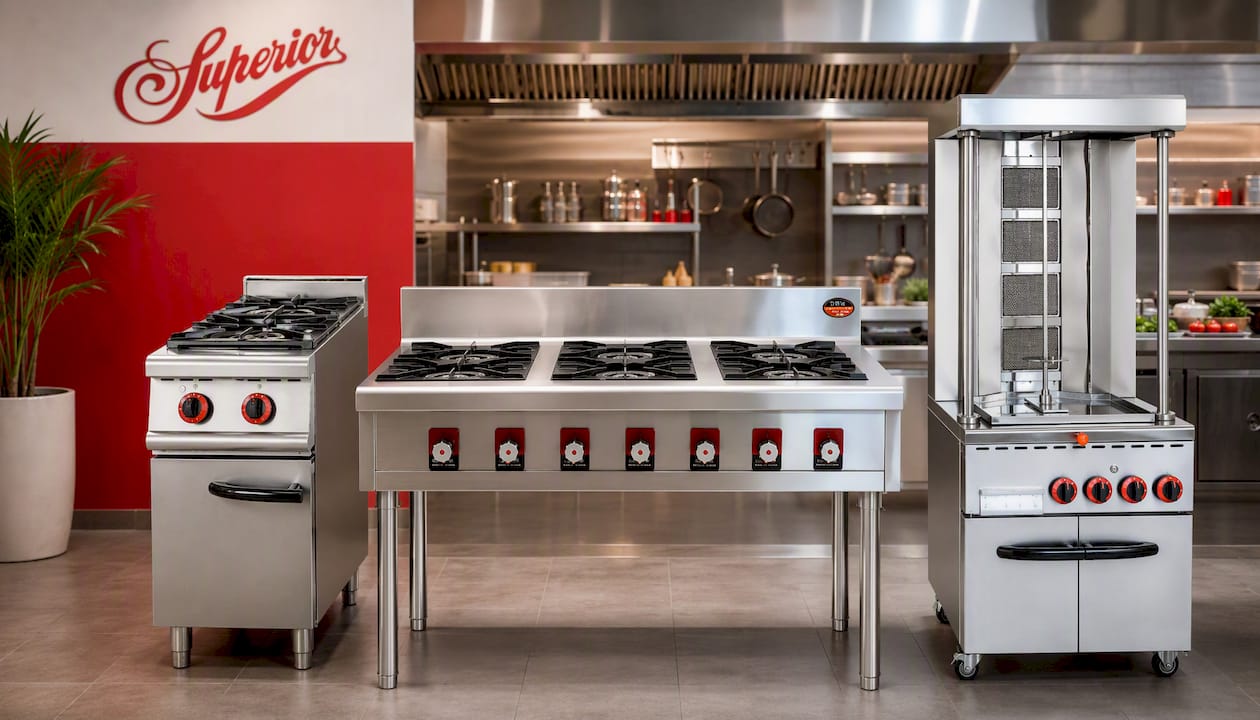
Our showroom lets you inspect a 2 Ring Standing Gas Stove, a 6 Ring Gas Stove, or a Standing Gas Kebab Machine in person before committing, and to check inlet specifications against the gas service pressure your LGSW has confirmed for your site. Energy-efficient models across our range may qualify for government grants and provide electricity savings, which can be important for businesses balancing compliance costs against a fit-out budget. Browse the full range of kitchen equipment or read practical operational guidance on the Kitchen Rush blog while planning your layout. Get in touch or visit the showroom to confirm which appliances suit your installed gas specifications before you order.
Sources
FAQ
Am I allowed to install my own gas oven?
No. Gas service work, including connecting or installing a gas oven, must be carried out by City Energy or a Licensed Gas Service Worker. DIY gas work is not permitted under Singapore’s regulations and carries real safety risk alongside legal exposure.
How can I get a gas pipe installed in Singapore?
Engage an LGSW or professional engineer to design the installation to SS 608 standards, then submit connection plans to City Energy as the gas transporter. Gas is admitted only after proof testing confirms the installation is leak free and the transporter issues a statement of admittance.
How should gas piping be installed if run under a building?
Piping run under a building or through inaccessible areas must still meet SS 608 design and material standards, and is typically placed on a three-year inspection cycle given the difficulty of accessing it later. Discuss routing with your LGSW early, since inaccessible sections are harder and costlier to repair once concealed.
How do I terminate a gas supply?
Contact City Energy or your gas retailer to arrange termination; do not attempt to disconnect or cap a live gas line yourself. The transporter or an LGSW will safely isolate and seal the supply, following the same proof-testing principles used when gas is first admitted.